The DNA in Every Breath: How Scientists Are Reading the Air to Track All of Life
A new study shows that shotgun sequencing of airborne environmental DNA can identify wildlife, track population genetics, detect pathogens, and even find illicit drugs — all from a simple air filter.
Contents 7 sections
The air around you right now is not empty.
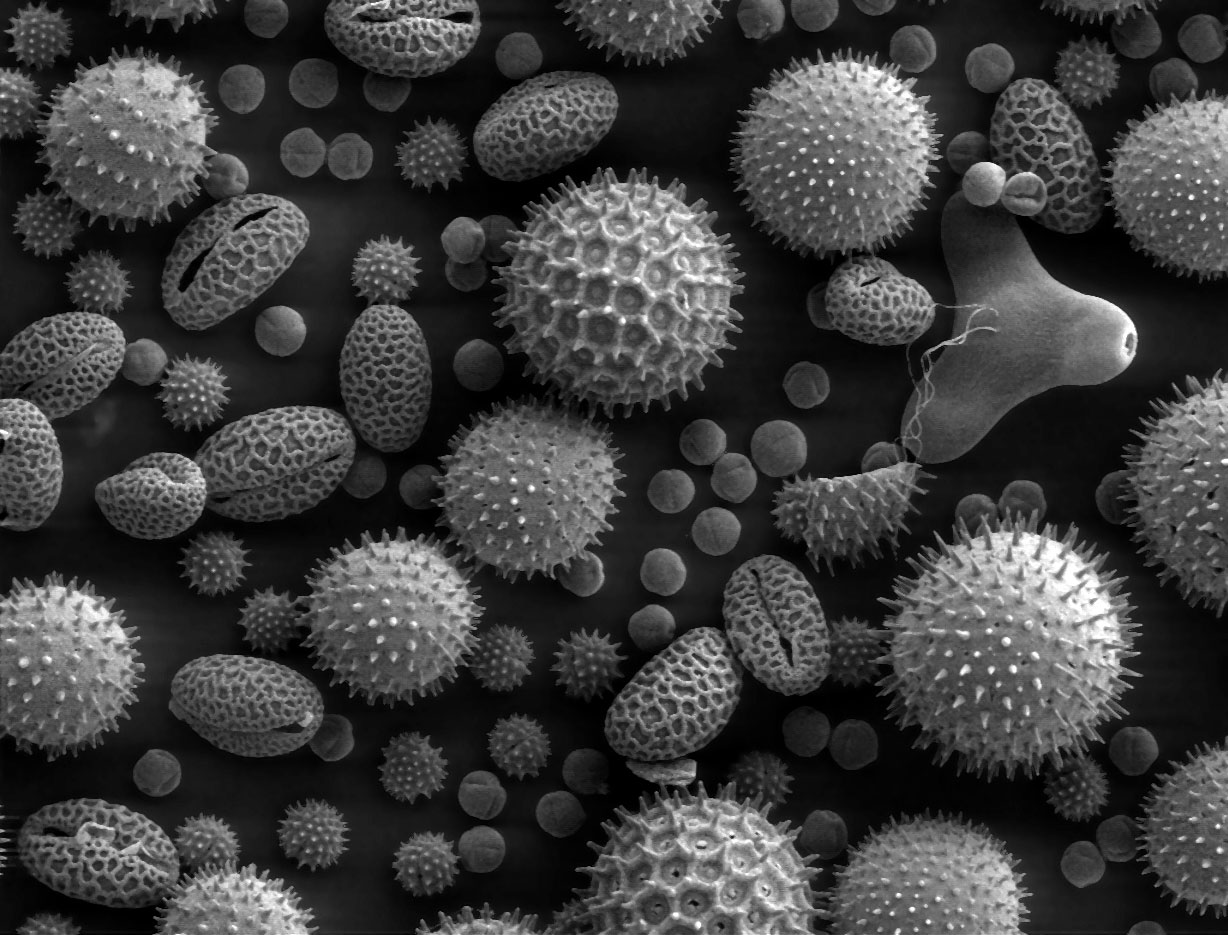
You already knew that in a physical sense — you’re breathing a cocktail of nitrogen, oxygen, water vapor, and invisible particulates. But here is what might surprise you: woven into those floating particles are tiny fragments of DNA from essentially every living thing that has recently been near you. Pollen from the oak tree three blocks away. Skin cells shed by the dog that padded through an hour ago. Spores from fungi growing on the underside of a leaf. Fragments of viral genome from a pathogen passing through on someone’s exhalation. Even, it turns out, genetic traces of cannabis from someone’s pocket.
All of it is drifting through the air. And now, for the first time, scientists have shown we can read all of it at once — not by searching for specific targets one at a time, but by scooping up the whole tangled message and sequencing everything simultaneously.
A study published June 3, 2025, in Nature Ecology & Evolution represents a striking leap in what’s called airborne environmental DNA (eDNA). Led by David J. Duffy, a wildlife disease genomics professor at the University of Florida’s Whitney Laboratory for Marine Bioscience, the team demonstrated that a technique called shotgun sequencing can extract detailed biological intelligence from the air — including, astonishingly, the ability to trace where individual animals came from, genetically speaking, without ever setting eyes on them.
What Is Environmental DNA — And Why the Air?
The concept of environmental DNA has been quietly reshaping ecological science for about two decades. The fundamental insight is simple: organisms shed genetic material constantly. Fish shed DNA into the water they swim through. Mammals shed it into the soil they walk across. Scientists discovered that by collecting and sequencing this genetic exhaust, they could detect species that were present without needing to catch, observe, or trap a single individual.
Early eDNA work focused almost entirely on water. You could toss a bottle in a lake, filter it, sequence the DNA, and reconstruct a species census of every fish and amphibian in the watershed. Conservation biologists went wild for this. Tracking rare and endangered species suddenly became far less invasive and far more efficient.
The obvious question: what about air?
At first, researchers were skeptical. DNA is fragile. Sunlight, oxygen, and temperature fluctuations degrade it rapidly. Surely the air, with all its ultraviolet radiation and turbulence, would shred DNA into uninformative fragments before you could collect enough to be useful.
That skepticism turned out to be wrong.
The first dramatic proof came in 2022, when Christina Lynggaard and colleagues at the University of Copenhagen published a landmark paper in Current Biology (DOI: 10.1016/j.cub.2021.12.014). They set up air-pumping stations inside Copenhagen Zoo and found they could detect the DNA of animals living in enclosures — okapi, meerkats, warthogs — from the air around their habitats, and even from the air in corridors 100 meters away. The air was full of biological signal. You just had to listen.
The following year, a team led by Joanne Littlefair at Queen Mary University of London made an equally remarkable discovery: air quality monitoring stations, which governments around the world have been running for decades to measure pollution, had been inadvertently collecting biodiversity data the whole time. Their filters, designed to trap particulate matter, were also trapping DNA. From two monitoring stations in the UK, Littlefair and colleagues identified DNA from more than 180 species — badgers, dormice, little owls, smooth newts, 34 species of birds, dozens of plant species — in samples that had been sitting in archives, unanalyzed, for years. That study was published in Current Biology in 2023 (DOI: 10.1016/j.cub.2023.04.036).
These were extraordinary demonstrations. But they shared a critical limitation.
The Old Approach: Looking for What You Already Know
Early airborne eDNA work almost exclusively used a technique called targeted metabarcoding: researchers would design PCR primers, molecular fishing hooks, for specific regions of DNA that are useful for identifying species. The most common target was a section of mitochondrial DNA (often the 12S or COI region) that varies enough between species to serve as a kind of genetic barcode.
Metabarcoding is powerful and sensitive. But it has a fundamental constraint: you can only find what you’re looking for. Your primers capture species whose DNA matches the hooks you designed. If you’re looking for vertebrates, you might miss the pathogen. If you’re looking for mammals, you might miss the plant. And you certainly can’t do anything like population genetics — figuring out where an individual animal came from, or whether two animals are related — because you’re only capturing a tiny fragment of the genome.
The 2025 paper changes the paradigm completely.
Shotgun to the Wind
Shotgun sequencing takes a different approach. Instead of fishing for specific targets, you shred all the DNA in a sample into fragments and sequence everything — indiscriminately, simultaneously, completely. Every fragment of genome from every organism present gets read. You then sort the resulting torrent of sequence data bioinformatically, mapping reads to known genomes to figure out what came from what.
This approach, applied to water or soil eDNA, is called environmental metagenomics, and it’s been transformative in microbiology. Duffy’s team applied it to the air — and the results were remarkable enough to justify the word “revolution.”
From Dublin city air, filtered and sequenced, they recovered DNA from hundreds of human pathogens — viruses, bacteria, and fungi that were circulating in the urban environment. Unlike targeted approaches, this surveillance was untargeted: it would catch novel pathogens, variants, and unexpected organisms without any foreknowledge of what to look for. Early warning systems for emerging diseases that work this way could one day be more powerful than any single pathogen test.
From the same Dublin air, they also found DNA from plants no one might have expected: cannabis, opium poppy, and psilocybin-producing mushrooms. These were not traces from nearby agricultural fields — they were genetic echoes of urban human behavior, floating quietly in the city’s breath.
But the finding that made scientists sit up was what happened in Florida.
Knowing Where the Bobcat Came From — Without Ever Seeing It
From air samples collected in a Florida forest, Duffy’s team extracted airborne eDNA from a bobcat (Lynx rufus). This alone would not have been especially surprising — several earlier studies had detected mammal DNA from air. The extraordinary part came when they applied population genetics analysis to the sequence data.
Shotgun sequencing generates genome-wide data — not just a barcode but thousands of genetic variants scattered across the genome. This is the raw material of population genetics, the field that uses genetic differences to trace ancestry, migration, and relatedness. Applied to human genetics, this kind of data tells you where your great-grandparents came from. Applied to wildlife, it can tell you whether an animal belongs to a Florida population or a Georgia population, and whether it’s related to animals sampled elsewhere.
Duffy and colleagues used the airborne bobcat sequence data to do exactly that: they determined the geographic origin of the animal whose DNA they had captured, without ever seeing the bobcat. Its genetic signature, drifting on the breeze from shed fur or skin cells, carried enough information to place it within the population structure of its species.
“That means you can study species without directly having to disturb them, without ever having to see them,” Duffy said. “It opens up huge possibilities to study all the species in an area simultaneously, from microbes and viruses all the way up to vertebrates like bobcats and humans, and everything in between.”
Why “Shotgun” Changes Everything
The difference between this paper and its predecessors is the difference between surveying a library with a specific reading list and reading everything on every shelf simultaneously.
With targeted metabarcoding, you ask questions you already know to ask. With shotgun sequencing, you collect answers to questions you haven’t yet thought of. The data you gather today could be re-analyzed in five years with better reference genomes or better analytical tools to reveal things you couldn’t see on the first pass. The air, in a sense, becomes a continuously updated archive.
Consider disease surveillance. Currently, respiratory pathogen monitoring involves targeted PCR tests for known viruses — influenza, SARS-CoV-2, respiratory syncytial virus. Shotgun sequencing of air filters would detect all of these plus any novel pathogen with a genome in its makeup. During the early weeks of the COVID-19 pandemic, such a system might have flagged the new coronavirus circulating in Wuhan air before the first patient was identified. This is not speculation — retrospective analysis has shown that wastewater sequencing, a similar approach in water, was detecting SARS-CoV-2 in municipal sewage before case counts were rising sharply.
Consider endangered species monitoring. The current gold standard involves camera traps, spotting scopes, tracking collars, scat analysis — all labor-intensive and costly. Airborne eDNA, processed by a compact device and cloud-based software (which Duffy’s team demonstrated can be accomplished by a single researcher in under a day), could deliver a species list for a whole ecosystem from a handful of air filter cartridges.
Consider invasive species early detection. Non-native species often spread invisibly for years before being noticed. Airborne eDNA surveillance could detect an invasive insect, plant, or pathogen from the genetic signal it leaves in the air before its population grows large enough to see with human eyes.
And consider conservation genetics. Tracking whether a small, isolated population of a rare cat or wolf is losing genetic diversity — a key indicator of extinction risk — typically requires trapping animals and drawing blood. That process stresses the animals, is expensive, and is impossible at scale. If the information you need is floating in the air, the calculus changes fundamentally.
The Privacy Question
The technology is not without complications, and Duffy’s team is admirably direct about one of them. Shotgun sequencing of air captures human DNA alongside everything else. In Dublin, that signal was almost certainly there — human skin cells, hair fragments, exhalation, all shedding genetic material into the urban air.
That raises serious questions. Could an outdoor air monitor be used to identify specific individuals? Could genetic information collected without consent from public spaces be used in ways that people would not sanction — forensic investigations, genetic surveillance, or commercial profiling?
Duffy and his co-authors have called explicitly for ethical guardrails for this rapidly developing field. These guardrails do not yet exist in a robust legal form. As the technology spreads — and it will, because it’s inexpensive, fast, and powerful — the conversation about its limits will need to catch up quickly.
There is something philosophically disquieting, too, about the idea that privacy increasingly cannot be assumed in outdoor space. That the simple act of walking through a city leaves a genetic trace in the air that persists, at least briefly, in readable form. It is the kind of disquiet worth sitting with, not to block the science, but to make sure the norms we build around it match the world we want to live in.
From Sea Turtles to the Sky
What I find quietly wonderful about this story is its origin. Duffy’s lab didn’t set out to revolutionize biodiversity monitoring. They were studying sea turtle genetics — trying to understand the population structure of these ancient, beautiful, threatened animals by reading DNA from water, sand, and soil around their nesting beaches. In developing better methods for extracting genetic information from environmental samples, they kept pushing the technique further.
Sea turtles taught them to listen to the world in a new way. And then they pointed that new listening at the air.
“The level of information that’s available in environmental DNA is such that we’re only starting to consider what the potential applications can be,” Duffy said. “From humans, to wildlife to other species that have implications for human health.”
This is how science so often works: a method developed for one narrow purpose turns out to be a key that opens completely different doors. The air around us has been carrying the story of the living world since there has been air. We just built the machine to read it.
The paper: Nousias et al. (2025). “Shotgun sequencing of airborne eDNA achieves rapid assessment of whole biomes, population genetics and genomic variation.” Nature Ecology & Evolution. DOI: 10.1038/s41559-025-02711-w
Earlier landmarks: Lynggaard et al. (2022), Current Biology (DOI: 10.1016/j.cub.2021.12.014) · Littlefair et al. (2023), Current Biology (DOI: 10.1016/j.cub.2023.04.036)